Techniques of your own
What it is
From Edge you can write sword techniques of your own beside the fifty arts. A technique is three parts: a stroke (how the blade moves), a release (how its force leaves you) and an intent (what it’s for), with your method’s element in all of it. You name it, give it a string of swings, and it goes off when you play that string. It ranks up as it lands on real foes, from Raw to Peerless.
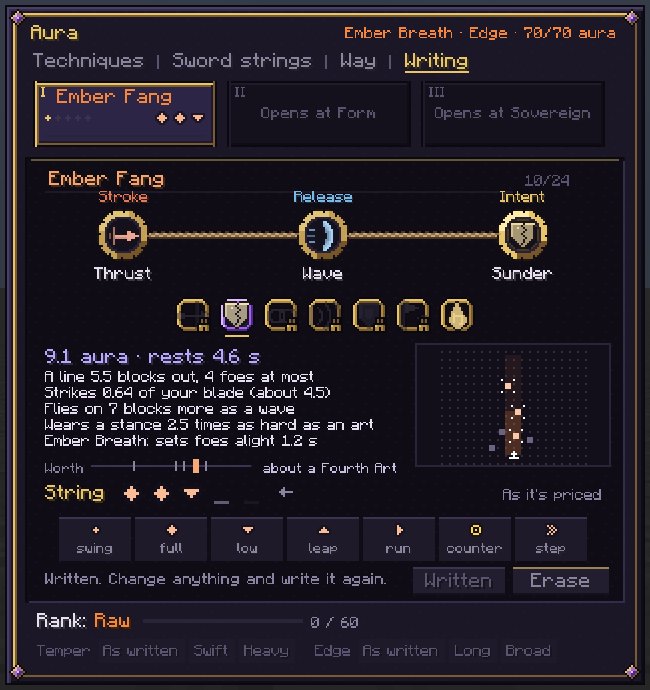 The writing page: a technique composed, named and given its string.
- What it is
- At a glance
- How to use it
- The parts
- Playing a technique
- Ranks
- How to get it
- Tips and counterplay
At a glance
| When | From Edge. One slot at Edge, a second at Form, a third at Sovereign |
| What | A stroke, a release and an intent, your method’s element in all of it, a name and a string of two to five swings |
| Where | The Writing tab on the Aura page (the Aura badge on the Cord screen, K) |
| Parts every blade knows | The Draw, On the Blade and Infuse, so your first technique can be written the moment you reach Edge |
| More parts | Technique scrolls in old places, a duelist you beat, a Sword Master’s first defeat, and your Way |
| Price | 3 to 13 aura, resting 1.5 to 6.5 seconds, from what it’s worth on the scale the arts were weighed with |
| Ranks | Raw, Honed (a temper), Tempered, Keen (an edge), Peerless (set its parts down on scrolls) |
| Kept | Your techniques, their ranks and every part you’ve learned are kept through death |
How to use it
Writing a technique
Open the Aura page and click Writing (it breathes gold while you have an empty slot and nothing written in it). At the top are your slots: click one to write in it, or to read what’s written there.
- Pick the parts. Three seals sit on a cord: Stroke, Release and Intent. Click a seal and its parts open underneath as sockets, each with its glyph: click one to set it (the next seal opens by itself). A part you haven’t learned is locked (hover it to see where it’s found); a part your Way lends has a dot of the Way’s colour.
- Read it. Under the seals the readout gives its price and rest, the shape it strikes (how far, how wide, how many foes), how hard (a share of your blade, and about how much that is with the blade in your hand), what its release and intent do, and what your method’s element adds. Beside it a small diagram plays the shape over a grid: the foes it would reach light up, a wave flies on, a burst breaks out, an afterimage strikes again. The Worth scale under the readout shows where it stands among the First to Fourth Arts, and which it’s most like.
- Name it. Click the name line and type (up to 24 characters; Enter when you’re done). Leave it empty and it takes a name from its parts, like Sundering Thrust Wave or Blazing Draw.
- Give it a string. Click the swings in the row at the bottom (swing, full, low, leap, run, counter, step) to compose its
string;
←(or Backspace) takes back the last one, a right click all of them. A line beside it says how demanding the string is. - Write it. The line at the foot says whether it’s ready, and Write writes it in. To clear a slot, click Erase twice.
You can’t write in the middle of a fight.
The string
A technique’s string follows the same rules as the arts’ sword strings, plus a few of its own:
- Two to five swings, with at least one mark: a low, leaping or running swing, a counter or a step cut. Full swings alone would go off by themselves in any fight.
- Not too plain. Each swing asks something of the hand (an ordinary swing nothing, a full one a little, a low, leaping or running one more, a counter or a step cut the most), and a string has to ask enough: full low is fine, swing low is too plain.
- Never the same as another. It can’t match one of your arts’ strings or another technique’s, or make either unplayable. When it overlaps an art, the line says which goes first.
- A demanding string is a little cheaper, an easy one a little dearer (two percent at most either way).
A technique’s slot card shows its name, its rank (as pips), its string and how far it is to the next rank.
The parts
Damage is a share of your blade, as the arts’ is. Every combination is weighed on the same scale as the fifty arts: the more it does, the more it costs and the longer it rests.
Strokes
| Stroke | Shape | Reach | Foes | Strikes | Its own |
|---|---|---|---|---|---|
| Thrust | A line down your look | 5.5 blocks | 3 | 1× the first, 0.7× the rest | Long and narrow |
| Rising Cut | 100° in front | 3.4 blocks | 4 | 0.8× | Throws its foes into the air |
| Falling Cut | 60° in front | 3.6 blocks | 2 | 1.12× the first, 0.6× the other | Heavy, and wears a stance 1.4 times as hard |
| Sweep | 170° in front | 3.3 blocks | 6 | 0.62× | Many foes, a little each |
| Spin | All round | 3 blocks | 8 | 0.58× | Every foe round about you |
| Draw | 110° in front | 3.8 blocks | 4 | 0.72× | The lightest and cheapest. Every blade knows it |
Releases
| Release | What it does |
|---|---|
| On the Blade | The stroke lands at once, where your blade reaches. Every blade knows it |
| Wave | The stroke, then a crescent of aura flying seven blocks past its reach (a spin’s as a ring racing out, a thrust’s as a lance), a quarter lighter, reaching a few more foes. A wall stops it |
| Burst | The stroke’s force breaking out all round you at once: lighter, but nobody near is left out |
| Afterimage | A lighter stroke now, and an afterimage of you left standing where you struck it, which strikes it again from there 0.6 seconds later. Step away and it still strikes where you were |
Intents
| Intent | What it does |
|---|---|
| Pierce | Through whatever stands in the way: 1.5 blocks further and three more foes, a little lighter. The Way of the Blade lends it |
| Sunder | Wears a stance two and a half times as hard as an art, toward an opening and your finisher |
| Bind | Roots each foe it strikes where it stands for 1.2 seconds (a player only briefly) |
| Echo | Strikes each foe again half a second later for half as much, wherever it has gone, if it’s still near |
| Ward | You take a fifth less from foes for four seconds after. The Way of the Bulwark lends it; the Rime and Dawn Masters teach it. No scroll or duelist carries it |
| Rally | You and your allies within eight blocks take a tenth less from foes for five seconds, and allied swordsmen build momentum. The Way of the Banner lends it; the Verdant Master teaches it. No scroll or duelist carries it |
| Infuse | Your method’s element twice as strong (an Ember technique burns longer, a Rime one chills deeper). Every blade knows it |
Your element
Every technique carries your method’s element, so the same parts play differently in different hands:
| Method | In every technique |
|---|---|
| Ember | Sets its foes alight |
| Rime | Chills them |
| Thunder | Interrupts the first foe it strikes, and a spark leaps on to a foe the stroke missed |
| Gale | Throws its foes back, and reaches a block further |
| Stone | Wears a stance harder, and staggers a creature |
| Verdant | Mends you a little for each foe struck |
| Hollow | Draws its foes in |
| Starlit | Gives a little aura back for each foe struck |
| Hourglass | A faint echo strikes its first foes again a moment later |
| Crimson | Opens a wound that bleeds, and drinks from it |
A method’s element is weighed in with the rest, so a Starlit technique’s aura or a Verdant one’s mending is paid for in its price, not given free. Infuse doubles it.
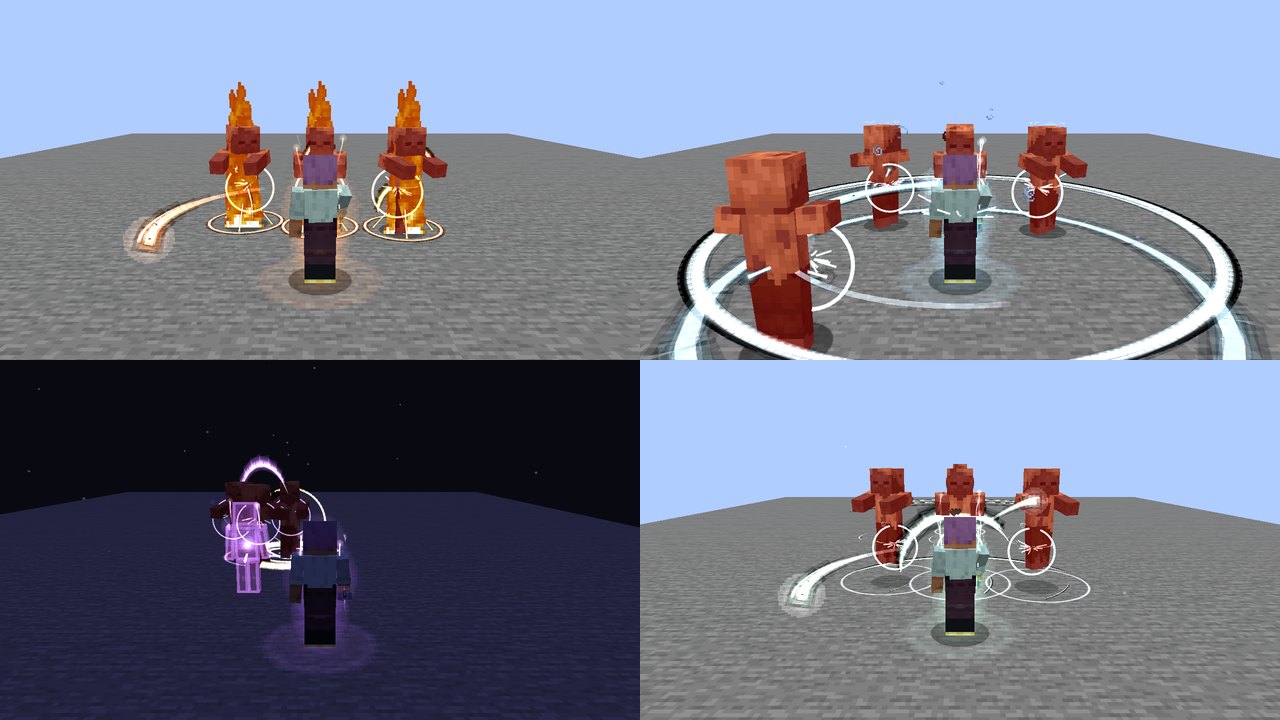 On the Blade (Cinder Sweep), a Burst (Frost Wheel), an Afterimage (Falling Shade) and a Wave (Rising Gale).
Playing a technique
Play its string and it goes off like an art, naming itself in your banner. Everything the arts follow, a technique follows too:
- Momentum makes it cheaper and stronger, and a technique that lands builds momentum like the art it’s most like.
- Its strikes wear a foe’s stance twice as fast as a blow (Sunder and the Falling Cut more), toward an opening and your finisher.
- While you’re awakened it costs nothing, as every art does.
- If you don’t know one of its parts any more (a Way’s, after you’ve left the Way) it rests, and its swings play whatever art they’d play without it.
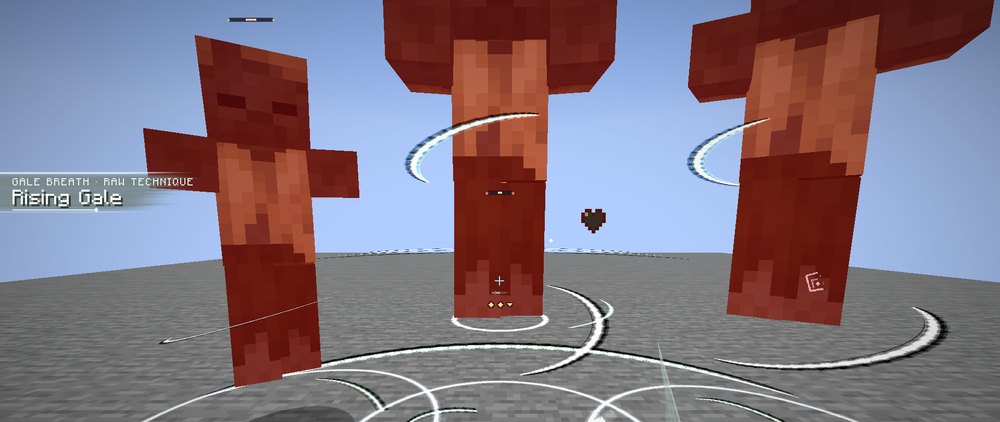 A wave through the swordsman’s own eyes: thin and low, the banner naming it.
Ranks
A technique ranks up as it lands on real foes: more for a stronger foe, for a bigger share of its health and for a kill, more in danger, and less for doing the same thing in the same place again and again. A training dummy teaches it a little, up to a point.
| Rank | Experience | What it opens |
|---|---|---|
| Raw | 0 | A shade lighter than it will be |
| Honed | 60 | A temper: Swift (a fifth lighter, its holds and burns too, and cheaper and quicker for it) or Heavy (a quarter harder, and dearer and slower for it) |
| Tempered | 200 | Its full strength |
| Keen | 520 | An edge: Long (reaches a quarter further, a wave a fifth further) or Broad (wider, and two foes more), each a little lighter |
| Peerless | 1300 | A shade stronger, its name rung out in gold, and its parts can be set down on scrolls |
Each rank strikes a little harder than the one before it (Raw a few percent under Tempered, Peerless a few over), always within the arts’ balance. Tempers and edges are chosen on the rank strip at the foot of the writing page; your first choice is free, and changing a choice already made costs two experience levels. A rank-up rings out with its own sound and banner and a line in your chat.
Ranks belong to the technique, not the slot: erase a technique and write it again (its parts and string the same) and its rank comes back, for up to twelve you’ve written.
Setting a part down
A Peerless technique’s parts can be set down on scrolls for another swordsman. Click a part’s glyph after Inscribe on the rank strip: it takes a paper and an Aura Shard (a fallen knight’s) and gives you a technique scroll of that part. The parts every blade knows, and those only a Way lends, can’t be carried on a scroll.
How to get it
Three parts are known by every blade (Draw, On the Blade and Infuse), so you can write your first technique the moment you reach Edge. The rest come from the world.
Technique scrolls
A technique scroll teaches one part: hold it and use it (you need a breathing method to read one). Its tooltip names the part, its family and what it does. A part you already know can’t be learned twice (the scroll isn’t used up), and one learned before Edge is kept for you until you reach it.
They turn up in the world’s old places of fighting, each place likeliest to hold certain parts:
| Where | Chance in a chest | Likeliest |
|---|---|---|
| Trial chambers (rare reward vaults) | 12% | Thrust, Wave, Pierce |
| Trial chambers (ominous vaults) | 25% | Falling Cut, Burst, Sunder |
| Ancient cities | 14% | Spin, Afterimage, Echo |
| Stronghold libraries | 10% | Falling Cut, Echo, Sunder |
| Bastion treasure | 16% | Falling Cut, Burst, Sunder |
| Jungle temples | 10% | Rising Cut, Bind, Afterimage |
| Desert pyramids | 8% | Sweep, Wave, Bind |
| Woodland mansions | 15% | Spin, Echo, Afterimage |
| Pillager outposts | 8% | Sweep, Rising Cut, Wave |
| The expeditions’ vaults (the Ember Sanctum, the Storm Spire, the Drowned Scriptorium, the Living Greenhouse, the Astral Observatory, the Clockwork Crypt, the Rootbound Maze, the Moving Sky Ruin and the Archive) | 20% | The parts that suit each one’s element |
| A fallen knight (dropped) | 6% | Any |
| The Buried Keeper’s reliquary in the Sword Tombs | Its reward | Spin, Burst, Afterimage, Sunder, Echo |
Duelists
Beat a wandering duelist and, besides what it teaches you, it shows you a part you don’t know yet before it goes, its own method’s favourites likelier (a Thunder duelist’s a thrust, a wave or a pierce; a Stone one’s a falling cut, a burst or a sunder).
Sword Masters
The first time you beat a Sword Master, it teaches you a part for good:
| Part | Taught by |
|---|---|
| Echo | Ember |
| Afterimage | Gale |
| Sunder | Stone |
| Ward | Rime, Dawn |
| Pierce | Thunder, Iron |
| Rally | Verdant |
| Bind | Hollow, Hourglass, Dune, Venom |
| Burst | Starlit |
| Infuse | Crimson (every blade already knows it) |
| Wave | Tide, Echo |
If you already know the part, the clear is still recorded.
Ways
Your Way lends you a part while you walk it: the Blade Pierce, the Bulwark Ward, the Shadowstep Afterimage and the Banner Rally. No scroll or duelist carries Ward or Rally; only a Master’s first clear teaches them for good. Leave the Way and its part goes with it: a technique written with it rests until you walk that Way again (or learn the part for good another way).
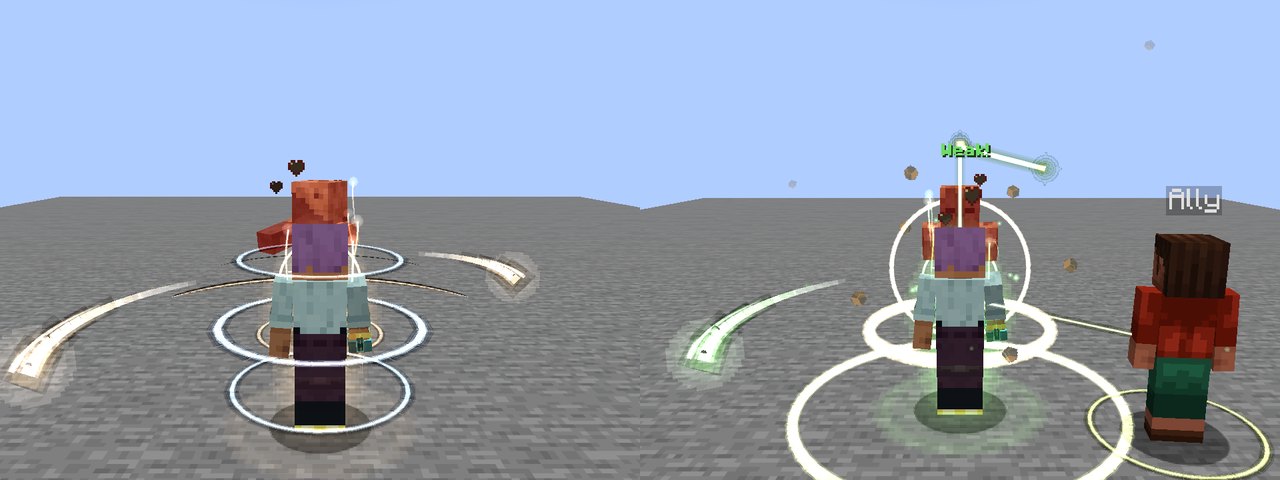 A Bulwark’s Ward and a Banner’s Rally.
Tips and counterplay
- Names are plain text. Everyone sees your technique’s name, so formatting and invisible characters are stripped.
- Never a one-shot. A technique deals one player at most 8 damage in all (after the PvP scale, before their armour and spell defences), like an art, and wears at most half of a player’s stance.
- Holds are short. A Bind roots a player for at most three quarters of a second, and nothing roots the same player again for a few seconds; burns, chills and throws are held as the arts’ are. Bosses are only ever slowed.
- Allies are only helped. A Rally steadies only your allies (teammates, or players who couldn’t harm you), never a rival.
- Nothing is griefed. Everything a technique leaves behind is light and shapes.
Server owners can switch techniques off, or scale their damage, rank speed and scroll chance.