Playing together
Everything that happens when casters meet: parties, sharing spells, fighting side by side, and fighting each other.
Parties
What it is
A party is a group of up to 8 players. Party members can’t hurt each other, and your helpful spells (heals, shields, buffs) land on them.
How to use it
| Command | What it does |
|---|---|
/party or /party list |
Shows your party |
/party invite <player> |
Invites a player. The invitation lasts 60 seconds. |
/party accept <player> |
Joins that player’s party |
/party decline <player> |
Turns down an invitation |
/party leave |
Leaves your party |
/party kick <member> |
Removes a member (leader only) |
/party disband |
Ends the party (leader only) |
- Only the leader can invite, kick and disband. If the leader leaves, the member who joined earliest becomes leader.
- You can send one invitation a second, with up to 8 waiting at once.
- Your party lasts through death and logging out, but ends when the server restarts.
The full rules are on the Parties page.
What a party does
- No friendly fire. Your spells, weapons, arrows and pets can’t hurt party members or their pets.
- Helpful spells reach them. A Heal aimed at a party member works, just as it does for a teammate.
- Chorus together. Party members count as allies for a chorus.
- Shared hearths. Party members can charge each other’s Runic Hearths.
- Duels still work. Two party members can still agree to a duel.
Sword Master trials
Up to 8 challengers can fight a Sword Master together. Being in a party doesn’t sign you up: each challenger joins the trial on their own. A party is still worth it, so your spells spare each other during the fight.
Sharing spells
| Way | What they get | Need the runes? | Need a Cord? |
|---|---|---|---|
| A spell code | The recipe, to thread themselves | Yes: only runes they know load | Yes |
| A Spell Scroll | One cast of your spell | No | No |
| A Knot | Your whole spell as one rune, for good | No | Yes, one that holds the Knot’s tier |
| The runes themselves | Runes to learn | They learn them from the items | Yes |
Spell codes
Every spell can be written as a short code that starts with wc:, such as wc:bolt.frost.split. A code holds up to
12 runes.
- Open the Cord screen (K), pick the spell and press Copy spell code.
- Paste it into chat. Everyone sees a spell card in the spell’s colour.
- Hover the card to read the spell. Click it to copy the code.
To load a code, copy it, open the Cord screen, pick the spell row to replace and press Paste spell code. Only runes you know and your Cord can hold are loaded; you’re told how many were left out.
A code carries runes only: no ranks, names or Knots. To share a Knot, give the Knot itself. See The Cord Screen.
Spell Scrolls
A Spell Scroll is one of your spells on paper. Anyone can cast it once, without a Cord or the runes.
To inscribe one: open the Cord screen, pick the spell and press Inscribe a scroll. It uses a sheet of Paper, an Ink Sac (or Glow Ink Sac) and twice the spell’s mana cost. Creative mode needs nothing.
- To read it, hold it and right-click. The spell goes off from you and the scroll is used up.
- A scroll casts at plain strength. The reader’s Heart Circles and gear don’t add to it.
- After reading a scroll, wait 1 second before the next.
- Scrolls stack to 16. Your first scroll earns the Scribe feat.
- Empty spells, and spells holding Reweave, Excise or Lesson Pack runes, can’t be inscribed.
- The reader is the caster, so the friendly fire rules are the reader’s.
A Runesmith sells paper and ink sacs.
Fighting side by side
Unison
Hit a foe with a different element within 1 second of another player’s hit, and your hit lands a Unison: it deals 50% more damage, and both of you earn the Unison feat.
- Two different players, two different elements, the same foe.
- A Unison never lands on a player.
- You don’t need to be allies.
Chorus casting
Cast the same shape at the same target as your allies, each within a second of the one before, and the last spell goes off up to twice as strong. See Chorus Casting.
Casters against casters
Domain clashes
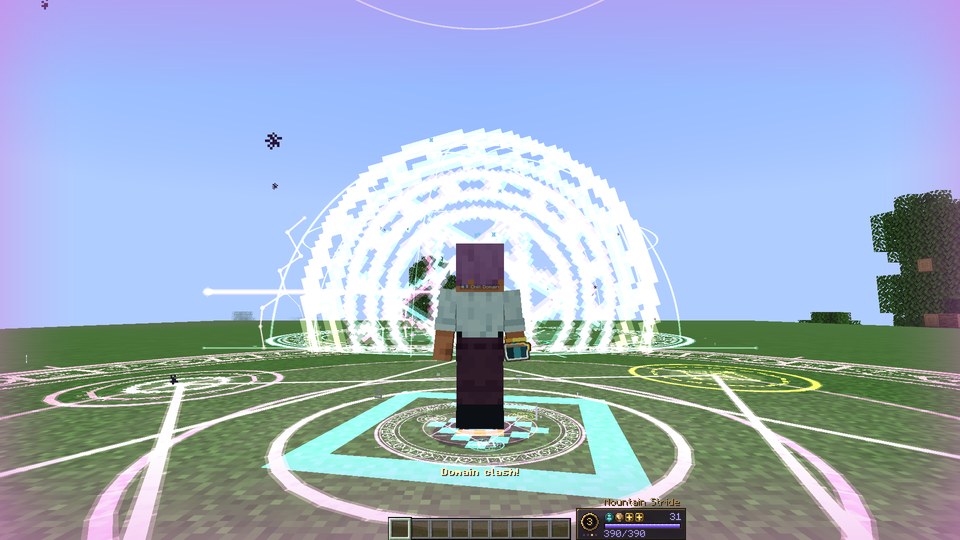 Two Domains meet: Domain clash!
Two Domains can’t overlap. When one opens into another, friend or foe, they push against each other for a moment and the weaker one shatters. Its spell ends. The winner earns the Domain Clash feat.
What makes a Domain stronger:
- Its power: everything that strengthens the cast, plus its own Focus and Vow runes.
- Your Heart Circles: each uncracked circle adds 10%.
- Its size: bigger is stronger, but not in proportion.
- A tie goes to the Domain that was there first.
See Shapes and Heart Circles.
Shooting spells out of the air
When your Bolt or Arc meets an enemy caster’s Bolt or Arc in flight, both burst:
| The two bolts | What happens |
|---|---|
| Same element | Both burst, harmlessly |
| Different elements | 5 damage to enemies within 2.5 blocks |
| A reacting pair | A named reaction: 8 damage to enemies within 4 blocks |
The reacting pairs: Fire and Frost (Shatter), Frost and Storm (Conduct), Fire and Wind (Wildfire), Void and Arcane (Implode), Fire and Storm (Overload), Earth and Frost (Fracture), Life and Void (Blight), Blood and Wind (Rupture), Fire and Time (Elapse).
“Enemy” means a caster you could harm, like a Runebound, or a player when PvP is on or you’re duelling. Allies’ bolts pass through each other. You earn the Spell Collision feat.
To stop spells aimed at you, see Shields and Parrying.
Friendly fire and PvP
Who your spells can harm
Harmful effects never touch:
- you (except movement on a Self spell),
- your own pets,
- your party and your scoreboard team, and their pets,
- players in Creative or Spectator mode, and armour stands,
- other players and their pets while PvP is off.
Everything else can be harmed.
Who your spells can help
Helpful effects only land on you, your own pets, your party and your team (and their pets). Without a party or team, a Heal aimed at a friend does nothing.
Player against player
- PvP on: your harmful spells can hit other players.
- Damage is scaled down: by default a spell hits a player for 60% of what it does to a monster.
- Duels override this for the two duellists, even inside a party. See Duels.
Monsters and familiars
A spellcasting monster’s spells hit players, their pets, golems and whatever it’s hunting, never other monsters. Your familiar follows your rules: it only harms what you could harm.
Who counts as allied
| Needs | |
|---|---|
| Helpful spells land on them | Your party or team (and their pets), or your own pet |
| Harmful spells avoid them | Your party or team (and their pets), your own pet, or PvP off |
| Chorus together | Party, team, or neither able to harm the other; not duelling |
| Unison | Any two players |
| Domain clash | Any two casters |
| Spell collision | Casters who could harm each other |